


Publications Vaira Law Firm
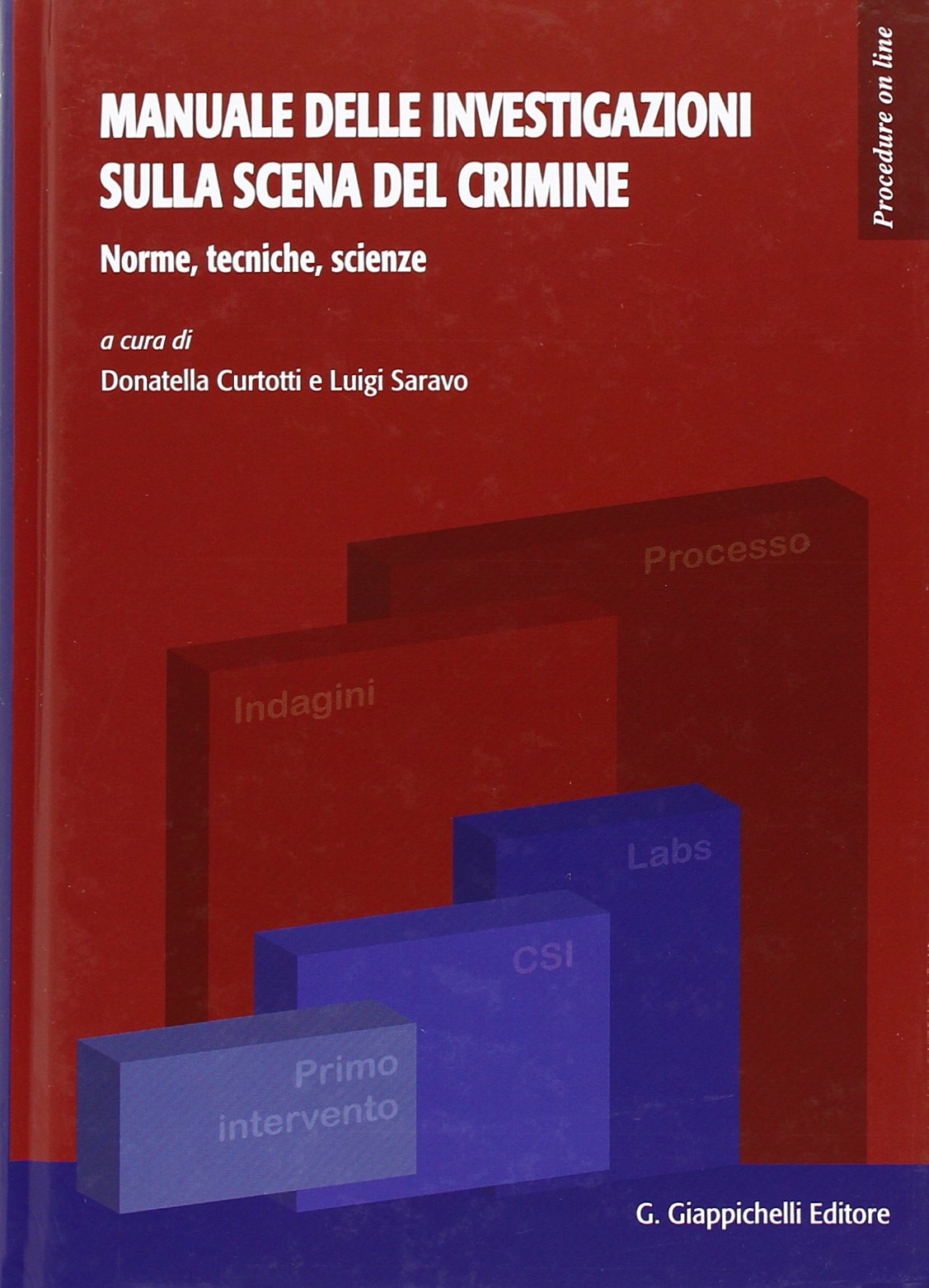
Manuale delle Investigazioni sulla scena del Crimine
AA.VV. a cura di Donatella Curtotti e Luigi Saravo
2013 – Giappichelli
Traces are the true “silent” witnesses to crime. They are always present and reliable because they cannot lie, they don’t forget, they don’t get confused, they can’t be wrong. Only human error in identifying and studying them can diminish their value. Today, the risk of errors is less pronounced than in the past. The crime scene is no longer an undifferentiated collection of tracks, left to chance and the investigator’s experience. The traces are sought, interpreted and found with logical rigor, scientific method and high technology, being able to provide a valuable contribution to the reconstruction of the fact. But the mistake is always possible. It is up to the criminal trial and its protagonists to identify it. However, the syllogism “scene-science-criminal evidence” proves difficult. The basic problem is that investigations on the locus commissi delicti escape the traditional rules of the evidentiary procedure. The ritual code is inadequate to accommodate the “new” technical-scientific products in the dynamics of the formation of criminal evidence, not paying much attention to the research phase of the source of evidence. The non-repeatable findings and assessments escape the rules and conceptual categories elaborated in 1988, ending up by projecting pre-established evidence taken from the adversarial case, which the defense was unable to control or balance with defensive investigations.
Codice Penale Annotato
a cura di Mauro Ronco e Adelmo Manna
2017 – IUS Pisa University Press
Even substantive criminal law has undergone a profound evolution by virtue of the new lymph that European law and the jurisprudence of the international Courts have poured into it. The ordinarily applicable ordinary rule must take into account not only the Constitution, but also the European Convention on Human Rights and the Charter of Fundamental Rights of the European Union. The experience of recent years has brought to light a fruitful dialectic among the higher courts, including the United Sections of the Supreme Court of Cassation with a strongly incisive role. The Courts operate in compliance with the principles of personal guarantee which constitute the patrimony of the common European legal civilization. However, each Court examines the issues from a specific angle. The Italian Supreme Court pays greater attention to general-preventive needs. The Constitutional Court and the European Court of Human Rights, dedicated to safeguarding the fundamental rights of the person, are inspired in particular by the guarantee needs of the individual. The Court of Justice favors the perspective of protecting the financial interests of the European Union.
This Code aims to promote the innovative approach to the study of the entire criminal matter, enriching the information assets of legal practitioners and enucleating the most significant elements of the European legal identity that emerge in the jurisprudential experience. The space of this Code is the European judicial one, in the light, always, of the primacy of the Constitutional Court, which has the competence to put any “counter limits” that guarantee the compatibility of European principles with those established by our fundamental Charter.
Codice dei reati contro la persona
a cura di Giandomenico Salcuni ed Enrico Infante
2018 – Neldiritto Editore
This code of crimes against the person represents a work in which the dogmatic tool is never separated from the awareness of the centrality of living law. The comment of the individual types of crime arises from a combination of doctrinal and jurisprudential knowledge, together with the solution of practical cases addressed in the form of questionnaires, combining theory and practice. Prodromically, each of the aforementioned cases has been the subject of a theoretical framework, with precise exegesis. In a second section, the most specifically practical cutting themes, and above all of the most pregnant thickness and complexity, were carefully selected, presenting more and more frequently certain indicators of difficulty regarding their systematic reconstruction. Finally, in a specific section, procedural formulas relating to more specific topics have been included for some institutions, in order to provide a valid contribution to those who carry out activities in the legal field. The work, updated with the latest news, represents an important aid for all those (magistrates, lawyers and students) who are called to deal with one of the most delicate sectors of the penal system, both from a working point of view and for the preparation of exams and competitions. Finally, the analytical index is highlighted, which can facilitate consultation of the work.


